There was a Tuesday last spring—I am almost sure it was a Tuesday—when our daughter laughed so hard at nothing that milk came out of her nose. I remember the feeling of it more than the facts: the kitchen light, the warmth of her on my hip, the way time briefly stopped being a to-do list. If you asked me for the date, I would have to guess. My partner, though, remembered the bowl on the counter, the song playing, the exact face she made a second before the chaos. I had the moment; he had the frame around it. Together, we still had the whole picture.
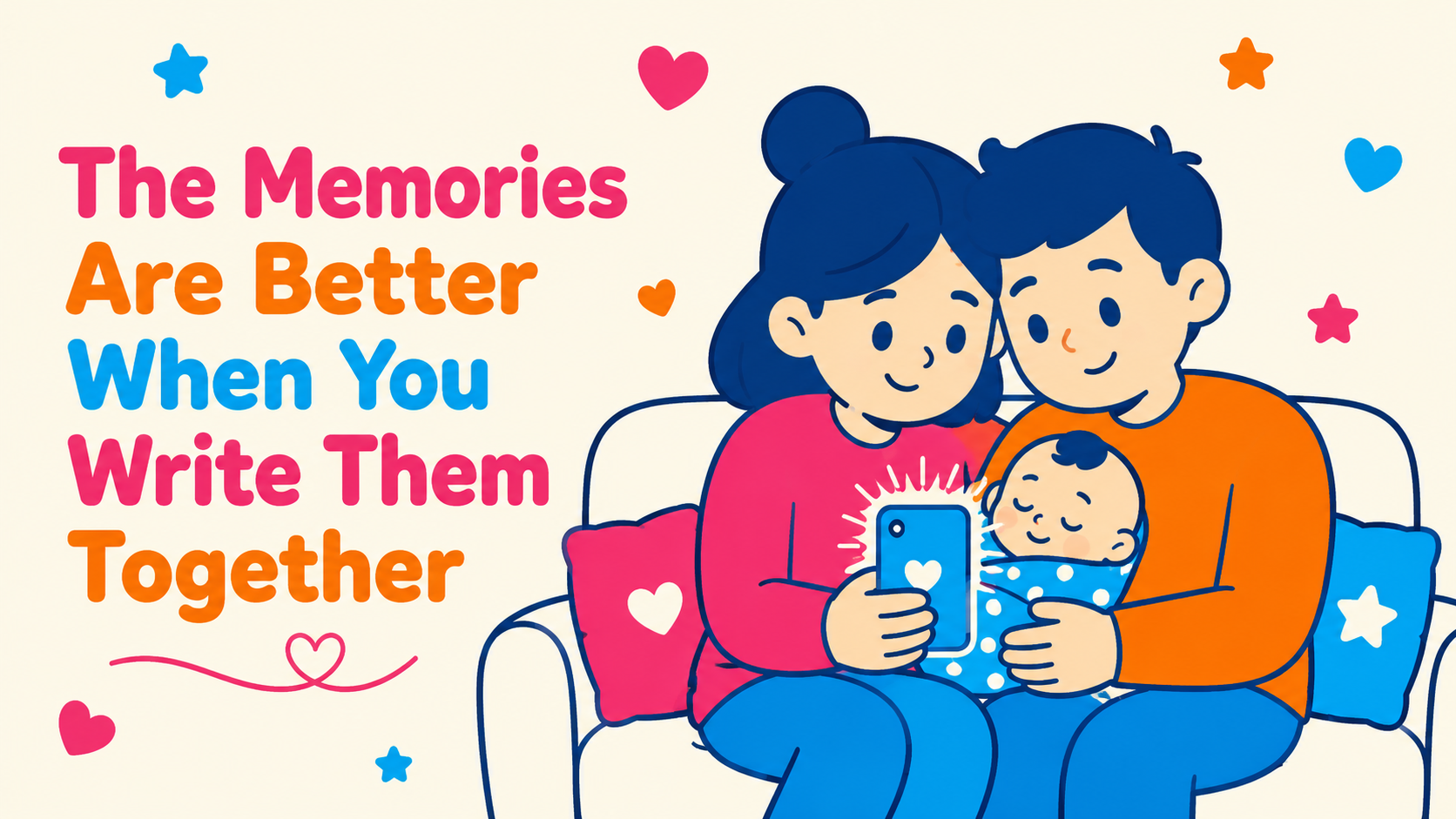
That is the quiet truth I wish someone had told me earlier: the memories are better when you write them together.
The science of shared memory (without the lab coat)
Psychologists have a phrase I love—transactive memory—from the late Daniel Wegner and his colleagues. In plain English, it means long-term couples often function like a small team with a shared hard drive. You do not each have to remember everything; you remember who is likely to remember what. One of you tracks birthdays, the other remembers how the car seat straps work. Over time, that division is not laziness—it is coordination. Your partner becomes part of your memory system.
Now flip that idea toward journaling together as parents. When you both document baby milestones—not perfectly, not daily, but honestly—you are doing something similar on purpose. You are building an external, shared place where details can live before sleep deprivation erases them. Research on collaborative memory and reminiscing in couples consistently points the same direction: talking and writing about shared experiences together tends to deepen encoding (how strongly a memory is stored) and elaboration (how many meaningful hooks it has to catch on later). You are not just saving facts; you are rehearsing the story in stereo.
Studies on older couples reminiscing together find something tender, too: joint recall is not only more accurate in bits and pieces—it is often more emotionally rich. One person fills a gap; the other adds texture. That is not trivia. That is how a life starts to feel whole instead of fragmented.
So when I say science backs this, I do not mean you need a spreadsheet. I mean your nervous system already likes partnership. Couples memory is not a buzzword—it is what happens when two people who love the same little human take turns saying, I saw this; did you see that too?
Why most parents journal alone—and what they miss
If you are keeping a baby milestone journal solo, you are in good company. One of you is often the default archivist: the photos, the pediatrician dates, the funny quote before it vanishes. The other parent is underwater at work, or on night duty, or simply not in the habit yet. There is no villain here—only logistics.
The cost is subtle. Solo journaling can flatten the story to a single lens. You write what you noticed, in the voice that comes easiest when you are tired. The tiny things your partner would have caught—the way she reached for his earring, the comment he whispered when she finally slept—never make it in because you cannot save what you never saw. Over months, that becomes a gentle skew: a beautiful record that still feels a little one-sided.
You also miss the repair work of memory. When memory is shared out loud or on a page, little disagreements surface (Was it raining? Was it Sunday?) and get resolved while you still have witnesses. Alone, you smooth the edges and move on. Together, you argue kindly about the weather and end up with a truer scene.
What changes when both of you contribute
When you document baby milestones together, the archive stops being a solo performance and starts feeling like a home.
Different eyes, different details. Maybe you remember the outfit; they remember the smell of the blanket. Maybe you chronicled the first word; they logged the mispronunciation that made everyone laugh a week later. A shared journal becomes a braid, not a line.
Different tones, same love. One of you might write three sentences after midnight; the other drops a voice note or a photo with a caption on Sunday morning. Neither has to be literary. The mix is the point.
A fuller story for your child someday. Kids love origin stories. When the record includes both voices, they inherit something closer to reality: not a polished myth, but a chorus. That matters more than perfect grammar ever will.
This is the part where I will name the tool without making it weird: we built Kidera so two parents can actually share one private timeline—photos, entries, and the kind of search that helps you find “first steps” when your brain offers only static. Not because software replaces feeling—but because journaling together as parents needs a door that stays unlocked for both of you.
Practical tips so it does not feel like homework
If the idea of a joint ritual makes you tense, good news: you are allowed to keep it small.
Lower the bar until it is almost silly. One line each from whoever is awake. A photo with three words. A milestone tagged on the right day even if the paragraph comes later. Momentum beats masterpiece.
Split roles loosely, not legally. Maybe one of you is “photo first,” the other “story first.” Maybe Wednesdays are theirs, weekends are yours. Swap when life intervenes. The goal is coverage, not fairness on a spreadsheet.
Use prompts that spark conversation, not pressure. “What made you smile today?” “What did they destroy gently?” “What do you never want to forget about this week?” Ask each other, then steal the best line for the journal.
Celebrate the overlaps. When you both write about the same day and the details do not match perfectly—keep both. That dissonance is data. It is proof you were two people in the same life.
Protect the intimacy. A couples memory practice is not performative. Pick a space that feels safe, private, and yours. If a tool helps, use it; if a notebook helps, use that. The medium matters less than the habit of returning together.
What this becomes when they are older
Years from now, your child will not care whether your sentences were elegant. They will care that the early years were witnessed—twice, from two angles, with love that showed up as attention.
I think about that milk-out-the-nose laugh again. On my own, it might have dissolved into “something cute happened once.” With my partner’s details stitched in, it is still a scene we can enter together. That is what I want for you: not a perfect archive, but a shared one. A baby milestone journal that feels like your family’s actual voice.
If you have been carrying the story alone, you do not have to carry it alone anymore. When you are ready, you can start your shared journal on Kidera—same timeline, both parents, no pressure to be poetic on day one. Just show up. The memories are better when you write them together.