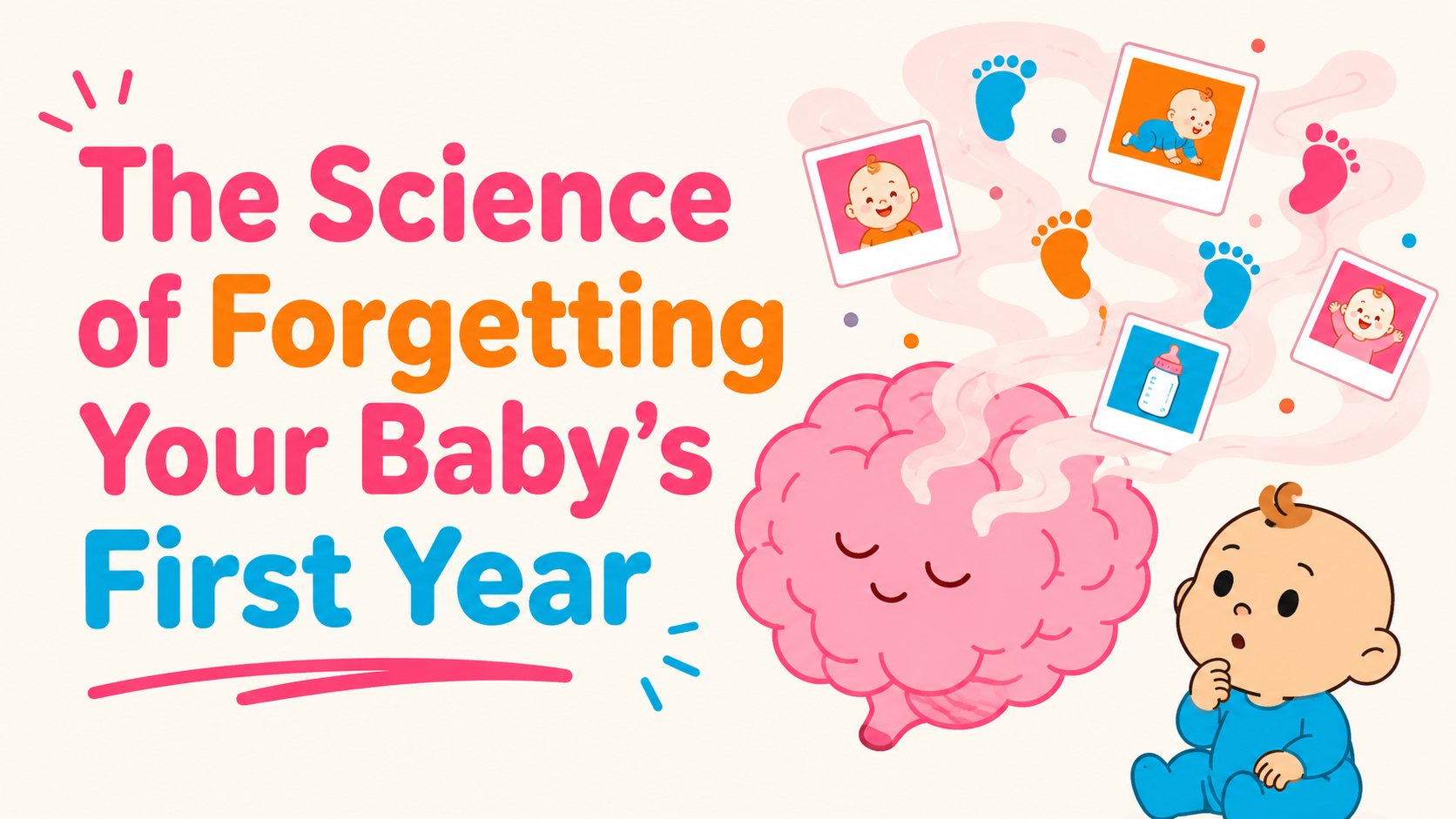
You are not imagining it: the first year really can feel like a blur. Neuroscience and psychology offer several overlapping explanations—not excuses for “bad memory,” but reasons why vivid moments still evaporate.
Sleep and memory consolidation
Sleep is when your brain consolidates memories—moving highlights from short-term processing into longer-lasting storage. New parents often get fragmented sleep, which reduces both the quantity and quality of consolidation. Fewer uninterrupted cycles means fewer chances for the hippocampus and cortex to replay and stabilize what happened during the day.
Stress, load, and attention
Caring for an infant means constant monitoring, interrupted tasks, and elevated arousal. Chronic stress can affect hippocampus-dependent memory formation. At the same time, your attention is pulled in many directions; what psychologists call encoding suffers when you never get a calm moment to notice and label what you experienced. You lived the week—you did not always get to store it as a story.
“Baby brain” is real—and narrower than the joke
Research on cognition around pregnancy and early postpartum has found mixed, modest effects—often things like verbal recall or processing speed—not a wholesale shutdown of intelligence. The takeaway that matters here: some kinds of recall can dip temporarily while your life reorganizes around a tiny human. That is compatible with feeling foggy about dates and details even when you feel sharp in other ways.
Your baby isn’t filling in the gaps later
Childhood amnesia means adults rarely retrieve episodic memories from their earliest years the way they remember age ten or twenty. Your child won’t seamlessly “remind you” of week twelve someday. For those months, you (and people you trust) are the living archive—photos help, but context erodes unless it is anchored somewhere.
Why “I’ll remember this” fails
Without retrieval practice—coming back to a moment and naming it—memories fade along something like a forgetting curve: unused traces weaken. A cute photo on your camera roll is not the same as a dated entry that says who was there and why it mattered.
A light role for Kidera
We built Kidera because the problem isn’t love—it’s bandwidth. A private journal with a calendar-backed timeline, quick entries, and searchable memory (including Ask Kidera on Pro) gives those fragile details a fair shot: one place for dates, words, and photos so “when did she first walk?” isn’t a fight with your past self.
Start free at app.kidera.co. If you’re exhausted, one sentence still beats zero—the science says rehearsing and organizing beats hoping you’ll recall it all later.